Friday, March 12, 2010
PEBBLE BEACH AT and T
Tuesday, February 9, 2010
THE AT&T PEBBLE BEACH
ELYSEE IS HAUNTING #18 AT PEBBLE BEACH ( You have to read the book.)
4th of JULY AT BLACKHORSE, FT.ORD. NOTE FLAG IN TOM'S HAT
ELYSEE TAKING A LESSON FROM BEN ALEXANDER PRO AT POPPY HILLS
LONE CYPRESS PEBBLE BEACH
Elysee and I leave tomorrow for Carmel where we are staying during the AT&T Pro-Am at Pebble Beach. We are Marshals at the tournament, yes I know, Marshall Marshals, or is it Marshal Marshalls. Anyway, I thought it fitting before we left to post some golf photos taken for my book about Carmel Our Summer in Carmel, Amazon.com
We have stayed three summers in Carmel and thoroughly enjoyed ourselves, but never playing Pebble Beach. Number one it is too expensive for my humble game and secondly, Pebble is very difficult to get on. You don't just call up a few days before and ask for a tee time. They are booked a year ahead, mostly for business events.
We have played many area courses though, getting special break at Ft. Ord's two very difficult tracks, a BIG break at the Navy course, Monterey Pines, as well as Pacific Grove, Carmel Valley Ranch, Rancho Canada and others.
We won't know our assignments until reporting in, but I;ll pass them on in case you want to see us shivering and wet on TV.
Here are a few pictures from the book.
Sunday, November 22, 2009
HISTORY OF CARMEL'S DEVELOPMENT-PART THREE
GRETEL 1925
HANSEL 1924
Two adorable Hugh Comstock fairy tale cottages epitomize Carmel's development.
Excerpted from my book: OUR SUMMER IN CARMEL-AMAZON.COM
Over the years, builders such as Hugh Comstock in the 1920s, constructed
quaint cottages that came to symbolize Carmel’s special character; and
special it really is! Paving the streets was a hotly debated development issue
opposed by many as an act of “boosterism” that catered to commercial
interests. Neon signs were banned, and even today, Carmel’s bars are not
allowed to have live entertainment because they would attract the “wrong
crowd.” But changes in lifestyle, over time, can erode even the strongest
will to resist altering what was once accepted and honored. Holding on to
the past while resisting the power of money and change is impossible. The
Carmel artistic colony today strives hard to retain its former charm. The city
clings to its unique traditions such as no mail delivery and no stop lights,
and promotes the arts to an extraordinary level considering its small size.
But one also gets the sense that paying homage to quaint traditions also has
something to do with presenting an attractive image; an image that caters to
what visitors have come to expect. Keeping Carmel somewhat like “earlier
Carmel,” is what the visitor is mostly looking for; but not necessarily what
residents today want for themselves. Tourism has won the battle that was
fought between earlier Carmelites, some of whom sought to preserve the
idea of an artistic enclave, and others who wanted to modernize and develop.
The city planning document of 1929 had an extraordinary mission statement,
especially considering the rampant commercialism of the time:
"The city of Carmel-by-the-Sea is hereby determined to be primarily,
essentially and predominantly a residential city wherein business and commerce
have in the past, are now, and are proposed to be in the future, subordinated to
its residential character."
Today, property interests, meaning the all-encompassing real estate
sector, dominate Carmel-by-the-Sea’s commerce. Housing is so expensive
only the elite can afford to own a home. The days of the underpaid
artist, poet, or writer starting out in life with little but their inspiration,
seeking the solitude of Carmel to nurture their talent among kindred
souls, has long ago left the scene. Carmel is delightful and entertaining.
The inhabitants are successful, culturally sensitive, and intelligent. Their
lifestyle is like few places in the world. But Carmel-by-the-Sea is no
longer a small town village or a unique place of artistic inspiration.
Sunday, November 8, 2009
THE STORY OF CARMEL'S DEVELOPMENT - PART TWO
FOREST THEATER WHICH WILL CELEBRATE ITS 100 ANNIVERSARY IN 2010
MARY AUSTIN, JACK LONDON, GEORGE STERLING, JIMMIE HOOPER ON CARMEL BEACH DURING THE EARLY BOHEMIAN PERIOD.
Excerpt from my book OUR SUMMER IN CARMEL: AMAZON.COM
It was during the time at the beginning of the century that San
Francisco became a lure for playwrights, poets, authors, actors and
actresses, which altogether comprised a bohemian society. Frank Powers, who was Devendorf's partner in the Carmel Development Company, and who was well-known to that bohemian circle, and espousing the virtues of his newly founded “Walden,” certainly attracted artists to experience the tranquil, forested, raw-natured seaside of, Carmel. Avant-garde artists about that time were seeking a refuge where they could indulge in the current idea that artists should lead simple lives thereby sharpening their artistic sensitivities. In Carmel they could farm and graze what food they needed, harvest the abundant abalone, take fish from the rivers, and hunt
in the woods. Frequent abalone feasts on the beach became the norm
and spontaneous outpourings of poetic verse were common. Leading this
artistic movement to Carmel was the poet, George Sterling. He came to
Carmel to be with “just one woman,” his wife, and to leave the drinking and
the womanizing life of San Francisco behind. He was thirty-six in 1905. His
“following” followed him. Jack London and Mary Austin; later Upton Sinclair
and a young Sinclair Lewis. Painters followed, awed by Carmel’s natural but
wild seacoast, exquisite light, ocean and surf, mountains and sea. It was a
special time for all of them. They lived like children in a rarified warp of
time. They had picnics on the beach at sundown, toiled during the day to eke
out a living on the land, and at night gathered together for wine and talk, all
the while encouraging each other’s talent and creativity. Bohemian enclaves
are heady wine for the young, the naïve, and the self-sufficient. They do not
outlast life’s reality. Jack London died of kidney disease in 1916. Sterling’s wife
did not find matrimonial solace in escaping to the woods of Carmel and the
promise of “just one woman.” She took her life by cyanide a few years after
London’s passing. A decade later Sterling killed himself by the same means.
This episode in Carmel’s history is covered in excellent detail by Franklin
Walker in The Seacoast of Bohemia. Many of the early bohemians drifted away.
Yet, a core few remained, becoming the seed of Carmel’s cultural future. The
word was out. Carmel held a special promise for those seeking solitude, those
who wanted to create, those who dared to think and act differently. It was
out of those early years from which today’s Forest Theater sprung, as well
as the Golden Bough Theater, the many renowned art and music festivals,
and the profusion of artists, actors, playwrights and others with a creative
aptitude who continue to live here today and, although in a very different
commercial climate make Carmel today a special place.
Sunday, November 1, 2009
THE STORY OF CARMEL'S DEVELOPMENT-PART ONE
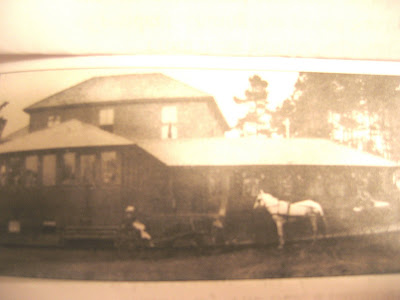
THE PINE INN AFTER RELOCATION. MIGHT EVEN BE DEVENDORF'S BUGGY.
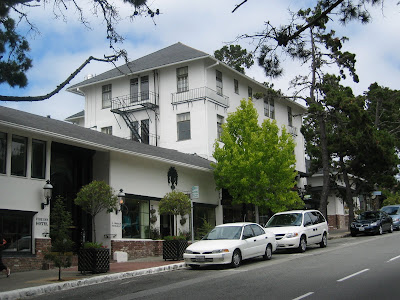
THE PINE INN TODAY EXPANDED BUT IN THE SAME LOCATION.
EXCERPT FROM MY BOOK: OUR SUMMER IN CARMEL, AMAZON.COM
The square mile incorporated city of Carmel-by-the-Sea, in addition
to the 120 galleries and art studios, also claims two stage theaters,
the internationally acclaimed Bach Festival, the equally renowned
Shakespeare Festival, a music society, and an annual art festival among
its more prominent cultural events. This focus on the arts is not a recent
Chamber of Commerce effort to boost tourism. Unlike other California
real estate developments around the turn of the 19th Century, from the
onset Carmel was a settlement of artists.
The original inspiration for developing Carmel came from the
neighboring town of Pacific Grove. In that small seaside community
during the 1880’s, a group of people representing the Methodist Church
established a summer retreat. A retreat that attracted adherents to
the Chautauqua Movement, a turn-of-the century Christian based,
cultural-enlightenment and self-improvement program. The original
developer of present day Carmel thought that, because of the Carmel
Mission’s proximity, (the Serra Mission incidentally was in the process
of restoration,) the developer could emulate Pacific Grove’s Methodist
oriented success with, in this case, a retreat for Roman Catholics. His idea
did not succeed for several reasons. First, Carmel was difficult to get to.
The developer’s promise (hope) that the railroad from Monterey would
be extended to reach the Carmel Mission never happened. Additionally,
in the early 1890s, the national economy entered into a recession, causing
the bloom to fade on California tourism and discretionary spending
for second homes. Adding to these woes was the reality that Carmel
was very isolated when compared to Pacific Grove, discouraging even
the wealthiest and most enlightened Catholics. The original Carmel
developer, Santiago Duckworth, in an attempt to redirect his marketing
plan away from duplicating the religious theme of Pacific Grove, had the
town renamed “Carmel-by-the-Sea.” He built a bathhouse on the beach
and a small hotel to accommodate buyers who remained overnight as they
pondered the purchase of a lot in Carmel. Duckworth’s efforts could not
overcome the geographic disadvantages, and he was rapidly running out
of money and personal enthusiasm. Enter Frank Devendorf.
Devendorf, when visiting the Monterey area several years earlier, had
seen Carmel beach and was enthralled by the scenery and landscape. He
was an experienced realtor, having been instrumental in the development
of such communities as Morgan Hill and Santa Cruz in the San Francisco
bay area. When Duckworth came to him, looking for a way out of his
Carmel project, it did not take long for Devendorf, who was already
captivated by Carmel, to swap real estate he owned in the Stockton area
for Duckworth’s Carmel holdings. The forty-six-year-old Devendorf
then teamed with Frank Powers, a successful San Francisco attorney,
heir to a family fortune from the gold rush days, and an energetic and
far sighted outdoorsman. Together, they made an unbeatable team, being
perfectly matched for the development of Carmel. Each man had his
own vision beyond just making Carmel a financial success.
Devendorf had always prided himself on building enduring communities, not simply
exploiting California’s real estate boom and bust cycle. He had a populist
background, influenced by Teddy Roosevelt’s politics and a Jeffersonian
heritage. Powers was a driven man, interested in the restoration of the
Carmel Mission and exploring the wild coast south of Carmel. They each
shared an interest in preserving the landscape, not an interest generally
ascribed to by developers during their time. Powers also brought
financial resources and legal and business connections to the partnership;
Devendorf, the on-site management savvy for real estate development.
They formed the Carmel Development Company in 1902, and the rest
is history.
Devendorf traveled by horse and buggy every Monday from his home
in Berkeley to his office in Carmel, where he would spend the remainder
of the week. He was the partner who showed the land, set the terms of
sale, and encouraged growth. Weary by Friday, he made the long trip back
to Berkeley. He was creative. He used log rollers to move the hotel that
Duckworth had built to a more central location in the middle of Carmel,
renaming it the Pine Inn. Greatly expanded, the Pine Inn is in the same
location today, a landmark Carmel hotel. Relocating the hotel was not an
easy feat. Ocean Avenue, at the time, was no more than a steep, rutted
and pitted grade cursedly named the Devil’s Staircase. During heavy rain,
it became an uncontrolled rivulet instead of a main street.
From these humble beginnings, just over one-hundred years ago Carmel began to grow from an inaccessable wilderness, and in so doing attracted a different sort of resident; one that would put its stamp on the character of the place, forever.
Tuesday, August 25, 2009
WHY CARMEL: PART THREE
CROWD PLEASERS AT THE MONTEREY BAY ACQUARIUM
(Excerpt from my book: OUR SUMMER IN CARMEL: AMAZON.COM)
Mother Nature’s gifts to Carmel and Monterey Bay are not limited to
its trees. The sand in places on Carmel Beach is strikingly white. This is
attributed to a prehistoric upwards thrust of the coast that exposed the
light-colored granite, which, over the ages, has been ground down to a
fine, white-powder-sand beach. Also, there is Carmel’s signature critter,
the sea otter. These playful animals are the darlings of the Monterey
Aquarium, but barely survived to this day because of their valuable
pelts; more sought after at one time than ermine or sable. They were
nearly hunted into extinction. Why the sea otter was so valuable is the
extreme thickness of its fur. Not having layers of fat like seals to protect
themselves from the cold waters of the California coast, the sea otter
developed a fur coat so thick, it has more hair per square inch than any
other animal, preventing the cold water from penetrating to their skin.
This also made them very valuable, especially to the Russian fur traders
who came farther and farther south along the coast in pursuit of these
mammals, an expansion that contributed to spurring the Spaniards to
action and finally settling Northern, California.
It would be possible to write an entire chapter about these incredibly
lovable mammals. How they roll onto their backs and pound a mussel
against a rock on their chest to get at the meat, nibbling at their meal
held in tiny paws like a gourmet sampling an appetizer. A mother nestling
an offspring against her chest is one of nature’s most maternal visual
images. Sea otters napping, as they wrap themselves in kelp and simply
drift with the current, are a poster for “sans souci.” They leave us with
the image of a whiskered face, looking like a wise grandfather, peering
at us with their dark brown eyes; a weary look saying that they have seen
more than we care to know. It was long thought that the sea otter was
hunted to extinction. But far down the wild and inaccessible Big Sur
coast a few survived. When Highway 1 was pushed through the region
as a depression era project, workers discovered a few long-surviving
small colonies of sea otters, which were quickly protected by the Federal
government. The entire central coastline is now a protected sea otter
preserve. It is estimated that, in the 1930s, there were only a small singledigit
number of survivors. There are about 2,800 today.
Sunday, July 26, 2009
WHY CARMEL? -PART TWO
Keep to the right. The Monterey Pine in the middle of the road has all other rights in Carmel.
Perhaps the world's most photographed tree, the Lone Cypress at Pebble Beach.
Excerpted from my book OUR SUMMER IN CARMEL; Amazon.com
Carmel's unusual climatic conditions contribute to several other natural
phenomena. One example is the Monterey Pine. This is the tree that
Cabrillo discovered in 1542 after which he named Cabo de Pinos. This
species of pine grows large, tall and straight, a shipwright’s dream-tree in
the sailing days of the 16-17th centuries. It is the world’s fastest growing
pine; some are known to grow ten feet in a year! Although this tree is
found in many places in the world today, it is indigenous to only a few
places in California, Monterey being the principle locale. It is understood
that the pine flourishes here because the moisture from the summer fog
nourishes it during what would otherwise be a drought season. It seldom
rains in Carmel from June to September. If you want to get into serious
trouble in Carmel, begin by messing around with the trees. Carmel has,
for years, treasured its forests and, for a city of only 4,000, has a full-time
warden just to look after the trees. You better talk to the warden before
you even begin to think about removing a branch, much less a tree.
Another tree found in abundance throughout the Monterey area is the
live oak. Their twisted branches, oftentimes just skimming the ground,
lend character to any landscape. But the queen of all Carmel’s trees, one
of the rarest species in the world, is the Monterey Cypress. Of the entire
world’s surface, this tree is indigenous to a tiny few acres on Point Lobos
and Cypress Point, each point thrusting itself out into the cool waters of
Monterey Bay. You see a picture of perhaps the world's most photographed tree, the Lone Cypress, a symbol of the Pebble Beach Company.A lone sentinel, drawing its strength from the craggy, fog-shrouded often
blustery, sea cliff. These rare trees have been the seed from which all the
Monterey Cypress in the world originated. They thrive here because of
the damp cool winds, passing over the fog-shrouded ocean, that deposit
life-sustaining droplets of water on their boughs. Clinging to rocky crags,
their branches reaching out almost beseechingly over the seaside cliffs,
welcoming the enveloping fog, they thrive where other trees cannot, and
cannot grow where other trees do.
Saturday, July 4, 2009
CARMEL/MONTEREY 4TH OF JULY-PART 2
The highlight of the afternoon festivities was an appearance by the
Comets of Bill Haley and “Rock Around The Clock” fame. Haley passed
away some years ago, but the other original five members of the group
had reunited and were enjoying international recognition. For their
years, could they still rock! Wow! Their average age was 76, with the
oldest band member being 84. Well beyond Viagra, and expected to be
in a retirement home? Not so for these guys! They presented a brilliant
show, displayed astonishing passion for their work, surprising vitality for
their age, and just shear joy in being before an audience and performing.
Their appearance was the highlight of the day. Filling a huge vacuum after
the Comets departed the stage, local politicians, headlined by the mayor,
and followed by several councilmen and so forth, tried their best to hold
the audience with patriotic speeches. But, in true American fashion,
most of crowd, including Elysee and I, drifted away to get a slice of the
free Fourth of July birthday cake.
Friday, July 3, 2009
CARMEL/MONTEREY 4TH OF JULY
Placing flags along Alvarado Street
Colors passing in review
Excerpted from my book OUR SUMMER IN CARMEL at Amazon.com
FOURTH OF JULY IN MONTEREY
The Monterey Peninsula is comprised of several small towns woven seamlessly together all hugging the cool waters of Monterey Bay, witheach community having its own distinct character. In Carmel there was a gathering at Devendorf Park, the social center of the village, with live music. Pacific Grove, a small former Victorian village separated from Carmel by Carmel Hill, was having its own parade. Seaside, a very patriotic community that borders Ft. Ord with many retired military personnel in residence, had already rolled out their annual parade two days earlier on a Saturday. Another choice to celebrate on the actual holiday was provided by the City of Monterey.
For Elysee and me, the Fourth of July is one holiday that should be
celebrated on the Fourth. Not the day before or even two days before
because it is more convenient. After reading about our options in the
local newspaper, none promised to compare with the small town Ol’
Fourth of July celebration being promoted by the City of Monterey. We
went there early in the morning on the fourth and were not disappointed
in our choice.
Elysee and I took notice of Monterey’s professional management
of the day’s agenda, the family atmosphere that prevailed, and the small town patriotism spiced with California’s inevitable submission
to diversity in the parade makeup. Talk about leaving “no one” behind!
The only surprising absence was that there was no gay marching band.
But we saw everything else, including middle-aged Middle East belly
dancers parading in the red white and blue. I never quite understood
their participation. As expected from a small town parade, children were
plentifully represented both in the parade and along the curb. There
were ample numbers of clowns to entertain them, many handing out
both small flags and candy. Truly, it was an affair for young and old.
As befitting the occasion, the townspeople and visitors assembled
along the main street of Monterey, Alvarado Street, and at the precise
scheduled moment of 10 o’clock the festivities began. About a platoon sized
unit of enlisted army personnel, singing and marching in cadence
paraded down Alvarado Street, led by a master sergeant. Each soldier
carried a medium sized United States flag mounted on a pole. The
soldier positioned this flag in a designated slot alongside the curb, and
then took the position of attention facing the flag. Once the entire halfmile
street was decorated, well-positioned loudspeakers called the public
to attention, and the national anthem was played. It was so well done,
impressive, orderly, and precise in its timing, that it set just the right tone
for the first parade element, the passing of the colors.
Thursday, June 25, 2009
CARMEL: WHY CARMEL? -PART ONE
Carmel Beach. Sun setting into the fog bank that is getting ever closer to shore.
Excerpted from my book, OUR SUMMER in CARMEL, Amazon.com
Why Carmel? Bearing in mind we are to consider the entire world each year for place to spend the summer, why Carmel? And why am I making repeated visits when I preach about the virtues of going to a different place each year? The simple answer is that I have an incurable attraction to the Monterey Peninsula. From the first time I drove through in December, 1964 upon returning from a year tour with the Army in Korea. It was love at first sight. I was seduced by the special appeal of Monterey and Carmel, witnessing the magnificent coastline and crashing waves along Seventeen Mile Drive in Pebble Beach, and the exhilarating drive South along the coast road, staying overnight in the Big Sur and dining at Nepanthe, before it became a hangout. I like so many before me wa stricken by what I call monterey malady; an insatiable urge to roam, explore and poke about the wonders of this magnificent meeting of land and sea. First and foremost Carmel, fits neatly into our criteria for a home-away-from-home. Having Celtic blood in my veins I do not seek summer beaches and 90 degree temperatures. The average maximum temperature for June, July and August is 68 degrees.; the average minimum 51. Moreover, of the 183 annual foggy days each year, most of them occur in the summer. Bless my Irish soul. Carmel fog is a sea fog which infiltrates the coastal pines in the late evening, soon engulfing the entire coast, and dissipating by mid-morning the next day. The fog often lingers off-shore all day, a constant reminder of the cool ocean waters awaiting any bather not fortified by a wet suit, and signaling a promise to return with the setting sun. To find out why this is read my book. I don't want to bore readers here with the special factors that contribute to Monterey's fog. Suffice to say the fog is a silent invasion that contributes greatly not only to the mystique of the region, but nurishes the special nature of its forests.
Subscribe to:
Posts (Atom)